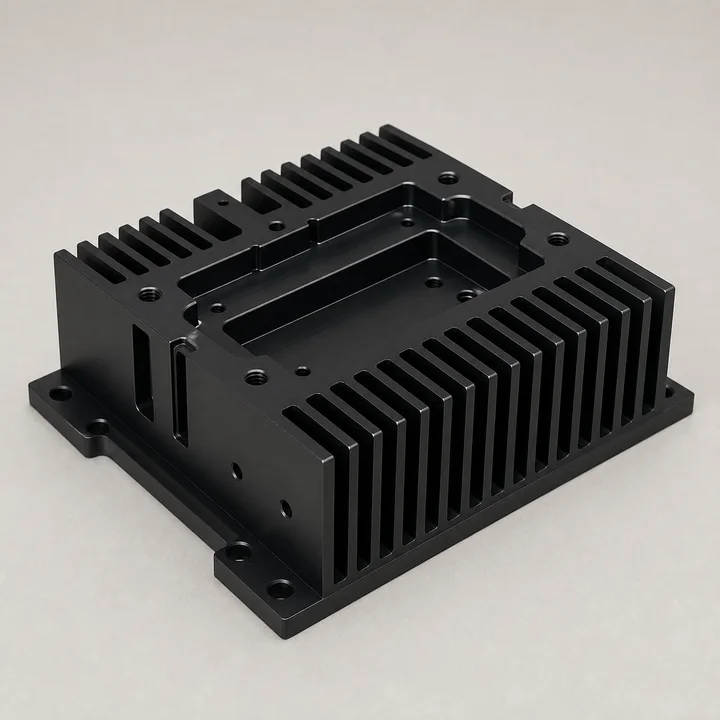
NorthLink builds compact 5G radio units for private wireless networks. Their power amplifier was running too hot inside a sealed, fanless enclosure, and the device junction temperature was creeping past the limit that governs both reliability and the amplifier's linearity — the thing that keeps the signal clean.
Heat is the ceiling on RF
A 5G power amplifier turns a lot of electrical power into a little RF and a lot of heat. In a fanless outdoor radio, that heat has one path out: through the device case, across a mounting interface, into a heat sink, and off to the air. If any link in that chain adds thermal resistance, the junction temperature climbs, the amplifier's efficiency and linearity degrade, and its rated life drops.
NorthLink's early sink was extruded and its device-mounting face wasn't flat enough, so the amplifier sat on high spots with air gaps in between — a thermal-resistance killer.
Flatness is the whole game
The single most important feature on a heat sink is the flatness and finish of the surface the hot device bolts to. A flat, smooth interface minimizes the gap the thermal interface material has to fill, which is where most of the avoidable thermal resistance hides.
That's a machining spec, not an extrusion spec. NorthLink needed the mounting boss machined flat and true.
The part we built
We machined the heat sink from 6063-T5 aluminum — a good thermal conductor and the standard alloy for this work — and held the amplifier-mounting interface flat to ±0.05mm with a fine finish, so the device seats with minimal thermal interface material. A black anodize adds emissivity for radiative cooling and protects the surface outdoors.
The fin geometry was set to NorthLink's airflow-free case, and we machined the mounting pattern to register precisely to their board.
Back inside the budget
With a genuinely flat device interface, the measured junction temperature dropped back under NorthLink's limit, restoring their thermal margin and protecting the amplifier's linearity and rated life. The same sink let them keep the enclosure sealed and fanless — no moving parts to fail in the field.
On an RF product, the thermal design sets the performance ceiling. A well-machined heat sink raised the ceiling enough to ship.
“Everyone obsesses over the fins. The win was a device face that was actually flat — that's where our thermal margin came back.”
Devon Pierce, RF Systems Engineer, NorthLink Wireless