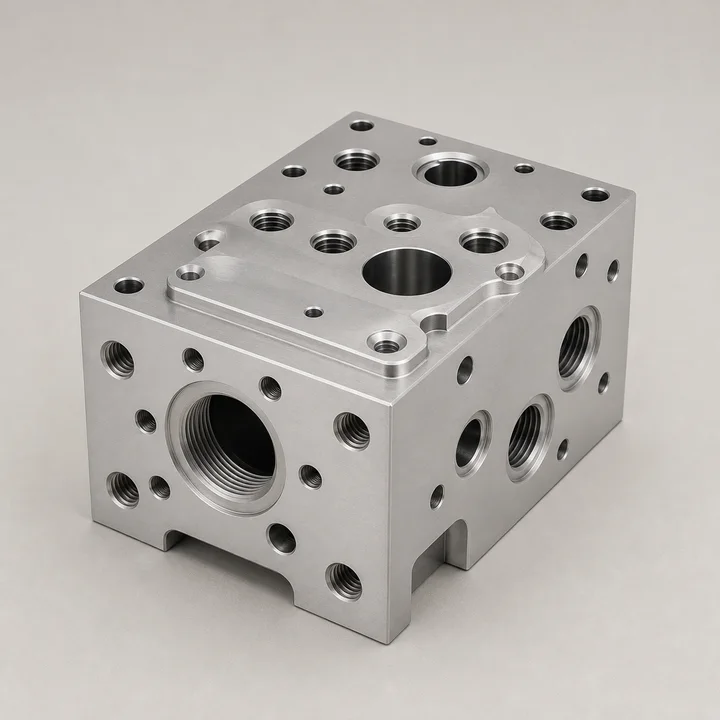
Ridgeline builds hydraulic power units for agricultural and forestry equipment. Their custom manifolds — the aluminum blocks that route high-pressure oil between valves — were coming back from their previous shop with weeping seal faces and burrs left in the cross-drilled passages, and every leak meant a teardown.
A leak is never just a leak
In a hydraulic manifold, a poor sealing face or a burr in a drilled passage doesn't announce itself until the system is under pressure. By then the unit is fully assembled and plumbed, so a single weeping port means draining the oil, disassembling, and rebuilding — expensive rework on what should be a finished product.
Ridgeline was seeing enough of it to hurt both their margins and their delivery promises.
The two failure modes
The first was flatness and finish on the O-ring seal faces: if they're not flat and smooth to tolerance, the seal weeps. The second was cross-hole intersections — where drilled passages meet inside the block, machining leaves a burr that, if not removed, breaks loose and contaminates the system or restricts flow.
Both come down to machining discipline: hold the tolerance on the sealing surfaces, and deburr the internal intersections properly, every time.
The part we built
We machine the manifold from 7075-T651 aluminum — high strength for the pressures a mobile system sees — holding critical bores and seal faces to ±0.02mm, with a hardcoat anodize for wear and corrosion resistance. Cross-hole intersections are deliberately deburred as part of the process, and blocks are cleaned so no chips or burrs remain in the passages.
First-article inspection confirms the geometry before production, and Ridgeline gets consistent blocks across runs from prototype quantities up through their production volumes.
Assemblies that hold the first time
With flat, in-tolerance seal faces and clean passages, Ridgeline's manifolds stopped weeping on the test stand, and the teardown-and-rebuild cycle that had been eating their assembly hours largely went away. Fewer leaks also meant fewer contamination issues downstream.
The manifold is the heart of the power unit; getting it right removed a whole category of rework from their build.
“Every leak used to mean draining a finished unit and starting over. Clean cross-holes and flat seal faces from Proco took that pain out of our build.”
Curtis Hale, Production Lead, Ridgeline Hydraulics