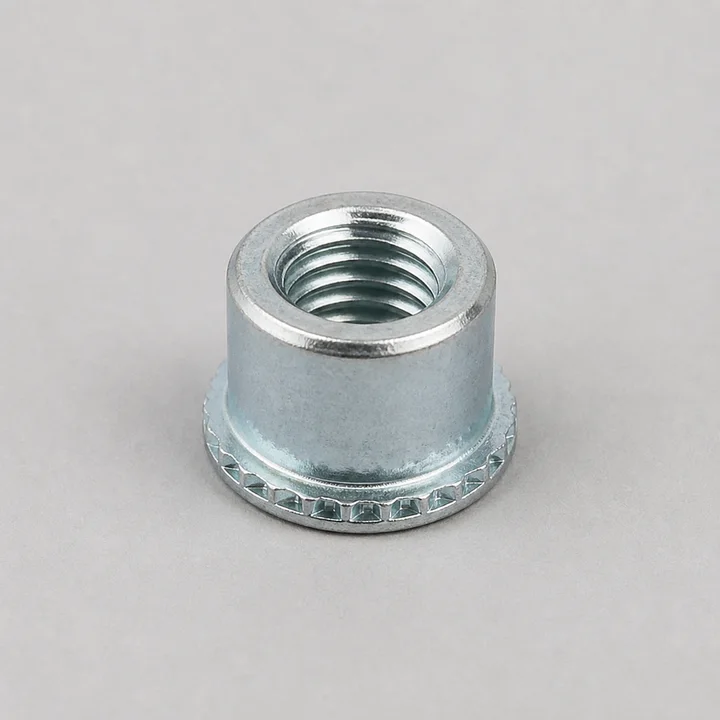
Cascade Instruments builds benchtop test equipment in sheet-metal chassis. To save a step, they'd been tapping threads directly into the thin steel — and thin sheet simply doesn't have enough material to hold a thread, so panels stripped during assembly and, worse, when customers opened units for service.
Thin sheet can't hold a thread
A tapped hole in 1.2mm steel has maybe a thread and a half of engagement. That's fine until someone torques a screw a little firmly, or removes and reinstalls a panel a few times during service — then it strips, and now there's no way to fasten the panel at all.
Cascade was catching some of these on the assembly line as rework, and hearing about others from the field when service techs stripped a cover screw. Neither is a good look on precision instruments.
Give the sheet a real nut
The established fix is a self-clinching nut: a hardened fastener pressed into a punched hole in the sheet, where it cold-flows the surrounding metal into a groove and becomes a permanent, load-bearing thread. It turns a weak tapped hole into a full-depth machine thread the sheet metal itself could never provide.
Cascade needed the right nut for their material thickness, installed correctly, with documentation for their quality system.
The part we supplied
We supplied M4 self-clinching nuts in heat-treated carbon steel with a zinc plate for corrosion protection, sized to Cascade's sheet thickness and hole, and held to the installation tolerances that guarantee proper clinch. Because we stock and supply these to spec with lot control, Cascade gets consistent fasteners and the material and plating documentation their program requires.
We also confirmed the punch and installation-force setup so the nuts seat flush and fully every time.
Threads that survive service
With self-clinching nuts, every fastening point became a real machine thread that torques to spec and survives repeated removal for service. The assembly-line stripping stopped, and the field failures — panels that couldn't be reattached after service — went away.
It's a small, standard part used correctly. For Cascade it turned a recurring quality complaint into a solved problem.
“We were stripping threads on the line and in the field. Clinch nuts gave every hole a thread that actually holds — the complaints just stopped.”
Julia Tan, Manufacturing Engineer, Cascade Instruments