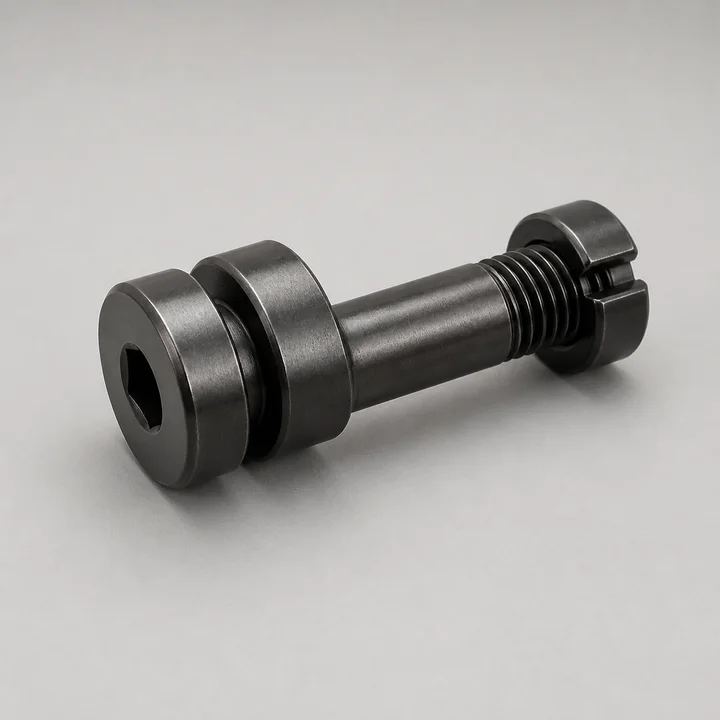
BeltWorks builds compact conveyors for packaging lines. Belt tensioning on their older design used a slotted bracket you loosened, pried, and re-clamped — awkward to set precisely and prone to slipping under load. They wanted tensioning to be a simple, repeatable adjustment an operator could make by hand.
Tensioning shouldn't be a wrestling match
A conveyor belt has to run at the right tension: too loose and it slips, too tight and it wears bearings. BeltWorks' slotted-bracket method meant loosening the tail pulley, prying it back against the belt while holding tension, and re-torquing — a two-hand, eyeball-it operation that often had to be redone, and that could creep out of adjustment as the machine ran.
They wanted a mechanism where a single controlled motion set the tension and held it.
An eccentric turns rotation into precise travel
The elegant answer is an eccentric shoulder bolt: the shoulder's axis is offset from the thread's axis, so rotating the bolt walks the pulley shaft through a small, precise arc of travel. Turn it to tension the belt, and the friction of the joint holds it there. It converts a fiddly linear adjustment into a controlled rotation with repeatable results.
The whole thing only works if the eccentric offset is machined precisely — an inconsistent offset means inconsistent tension.
The part we built
We machined a custom eccentric shoulder bolt from 4140 alloy steel for strength and wear resistance, holding the eccentricity to ±0.02mm so every bolt delivers the same travel per turn. A black-oxide finish resists corrosion in a packaging environment. Because it's a custom part, we tuned the offset and shoulder dimensions to BeltWorks' exact pulley geometry.
We run it from prototype quantities up through production so BeltWorks could validate the mechanism before committing to volume.
A quarter turn, and done
The redesigned tensioner lets an operator set belt tension by turning a single bolt — no prying, no second wrench, and consistent results because the eccentric offset is the same on every machine. Belts stopped drifting out of tension in service, cutting the slipping and re-adjustment that had generated support calls.
A conveyor is a simple machine until a detail like tensioning makes it fussy. One custom bolt made that detail disappear.
“We turned a two-wrench wrestling match into a quarter turn. The precision on that eccentric is what makes every machine tension the same.”
Greg Salava, Design Engineer, BeltWorks Conveyors