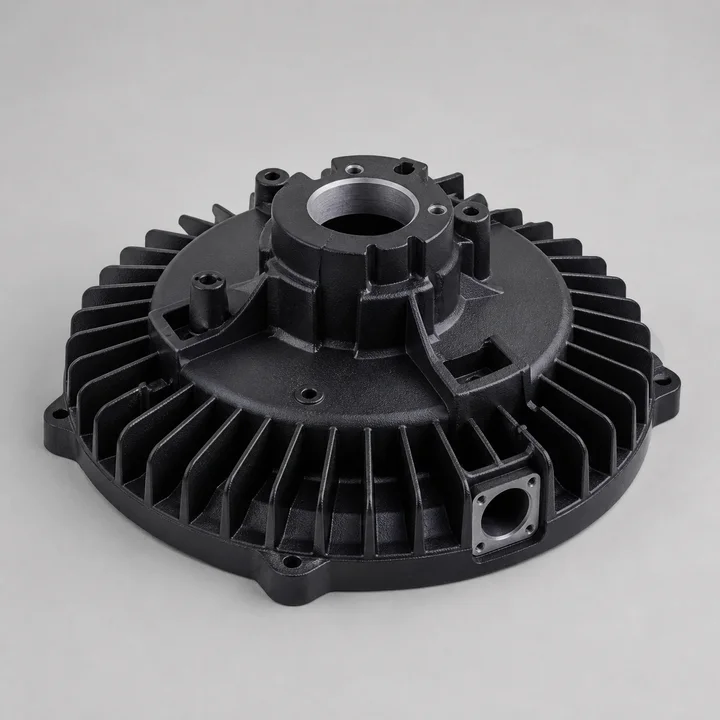
Lumen Field builds LED area luminaires for parking lots and building exteriors. Their fixtures were assembled from an extruded heat sink, a separate housing, and a handful of brackets — a lot of parts, a lot of thermal interfaces, and LED junction temperatures higher than they wanted, which quietly shortens LED life.
Every joint is thermal resistance
In an LED fixture, the LED's life and light output depend on how cool you keep the junction. Heat has to move from the LED board into the sink and out to the air, and every mechanical joint along the way — board to sink, sink to housing — adds thermal resistance and a place for the design to underperform.
Lumen's assembled approach had several such joints, plus the labor and part count of bolting it all together. They wanted to consolidate.
Cast the whole thing as one part
Die casting lets you integrate the fins, the LED-mounting boss, the housing walls, and the mounting features into a single aluminum part. That removes internal thermal joints — the LED board mounts straight to a cast boss that's continuous with the fins — and collapses a multi-piece assembly into one casting.
Aluminum die casting is the workhorse of LED thermal management precisely because it turns complex finned geometry into a repeatable, low-cost part at volume.
The part we built
We die-cast the heat-sink body in ADC12 aluminum — the standard high-fluidity casting alloy that fills thin fins cleanly — with the LED boss and mounting features cast and machined to a CT7 tolerance grade, and a black powder coat for a durable outdoor finish and good thermal emissivity. The LED board now mounts to an integral cast boss, eliminating an interface.
We can finish, machine, and coat the casting in-house, so Lumen gets a ready-to-populate body rather than a raw casting they have to process.
Cooler LEDs, fewer parts
Consolidating the housing and sink into one casting lowered the measured LED junction temperature by removing internal thermal joints, which directly extends the LED life Lumen warranties. It also cut the fixture's part count and assembly labor, and gave the product a cleaner, more finished look.
A die casting traded a bag of brackets for a single part that cools better — the kind of change that helps both the datasheet and the bottom line.
“Casting it as one body took out the thermal joints and half the hardware. The LEDs run cooler and the fixture looks better.”
Nadia Kessler, Product Engineering, Lumen Field Lighting