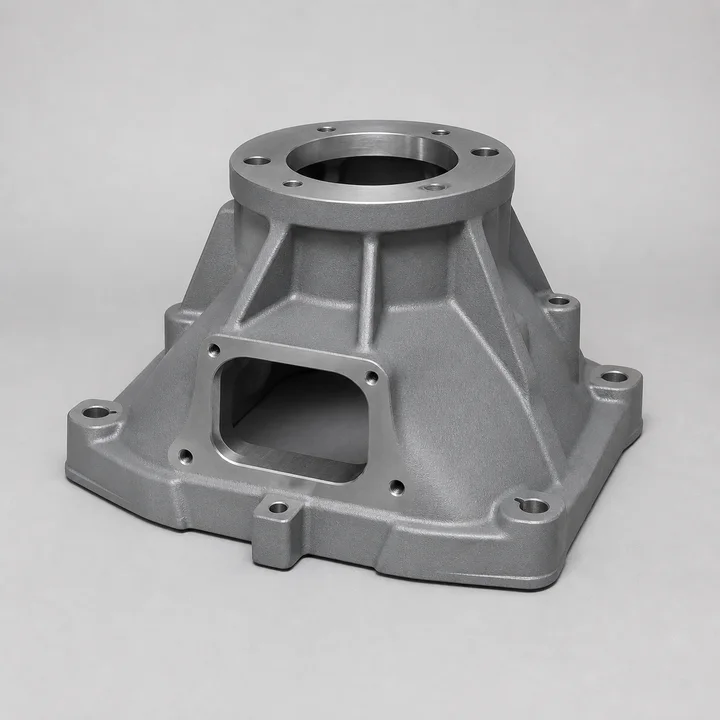
Handit integrates collaborative robots into pick-and-place cells for small manufacturers. As their customers pushed the cobots toward heavier payloads and faster moves, Handit's fabricated steel-plate pedestals began to flex and resonate — and a base that moves under the robot shows up directly as placement error at the gripper.
The base has to not move
A robot arm is only as accurate as what it's bolted to. When a cobot accelerates and stops, it puts real reaction loads into its base; if the base deflects or rings, the tool point overshoots and settles slowly, and repeatability suffers. At light payloads Handit's welded pedestals were fine. Pushed harder, they flexed.
Handit needed a base with more stiffness and, just as important, a truly flat and accurately located robot-mounting interface so the arm sat square.
Cast geometry beats welded plate
A casting can put material exactly where stiffness is needed — internal ribs, thick bosses, a shape optimized for rigidity — in ways a weldment of flat plates can't match, and without the residual stress and distortion welding introduces. Cast in aluminum and then machined at the interfaces, it's both stiffer for its weight and dimensionally repeatable.
That combination — designed-in ribbing plus machined datums — is what turns a base from a source of error into a solid foundation.
The part we built
We cast the pedestal in A356-T6 aluminum — a strong, heat-treatable casting alloy — with internal ribbing for stiffness, then machined the robot-mounting interface and the floor-mounting pads to a CT8 tolerance grade so the arm mounts flat and square. A gray powder coat finishes it for the plant floor.
We machine and finish the casting in-house, so Handit receives a pedestal ready to bolt a robot onto, with the mounting pattern true to the arm.
Steady at higher payload
On the cast pedestal, Handit's cobots held their placement accuracy at the higher payloads and speeds that had made the welded bases flex, because the stiffer base and flat interface stopped the wobble and settling. That let Handit quote more demanding applications with confidence.
A robot's specs assume a rigid mount. The casting finally gave the arm the base its datasheet was written for.
“Our welded bases flexed the moment customers pushed the payload. The cast pedestal is stiff and flat — the robot finally has something solid to stand on.”
Lena Kovac, Systems Engineer, Handit Automation